Some resources and concepts on experimental music

This weekend the Department of Music at Cornell University has been hosting a stellar conference called After Experimental Music, featuring a solid number of leading thinkers and practitioners in experimental music, electronic music, sound studies, and all strands of musicology. Here are some notable concepts and sources referenced by some of the speakers.

George E. Lewis (Columbia University), New Music, New Subjects: The Situation of a Creole

  • fluctuating stasis
  • Alvin Curran, “new common practice”
  • Van Wyck Brooks, “On Creating a Usable Past”
  • Gayatri Cahkravorty Spivak, Can the subaltern speak?
  • Patrick Chamoiseau, Jean Bernabé and Raphaël Confiant: Eloge de la créolité
  • Louis Andriessen, De Materie
  • James Rolfe, Beatrice Chancy
  • Johannes Kreidler and new conceptualism; Fremdarbeit
  • Coco Fusco, “The Other History of Cultural Performance” and English Is Broken Here
  • Julian Carillo and “Sonido 13”

Valentina Bertolani (University of Calgary), Comparing the Networks around the Journal Perspectives of New Music and the Magazine Source: Music of the Avant-Garde (1967–1970)

  • Robin Nelson, Practice as Research in the Arts
  • ASPEN multimedia magazine
  • Karlheinz Stockhausen, die Reihe

Kwami Coleman (New York University), The ‘New Thing’ as Polemic: Aesthetics as Identity, 1965–1967

  • Harvey Pekar, “The Critical Cult of Personality”
  • Cornette Coleman: spontaneous group improvisation
  • “Don Cherry” by LeRoi Jones
  • Édouard Glissant, opacity

Jordan Musser (Cornell University), Hearing across Oceans of Sound: Experimental Listening and the Global Imaginary at the London Musicians Collective

  • Michael Nyman, Experimental Music: Cage and Beyond
  • Andrew J. Eisenberg, “Space” in Keywords in Sound
  • David Novak, Japanoise
  • Benjamin Piekut, “The World is a Problem”
  • David Toop, “New/rediscovered musical instruments”
  • Derek Bailey, Improvisation: Its Nature And Practice In Music
  • Eno – Music for Airports and Roquet on ambience

Ellie Hisama (Columbia University), discussant

  • Ferneyhough – concept of “inner ear”

An additional source: Experimentalisms in Practice: Music Perspectives from Latin America, edited by Alejandro Madrid, Ana Alonso-Minutti, Eduardo Herrera

Resources for learning Cayuga

A number of friends and colleagues have recently asked me how I’m going about learning Cayuga independently, so here’s a list of resources I’m using for learning the Cayuga language:

  • Wadewayęstanih, 2nd edition with updated orthography, is my main textbook and source of dialogues. Audio was available on cayugalanguage.ca (now down; see below), but luckily it was captured by the Web Archive, so you can download a zip file with audio for the dialogues from all 36 chapters. The zip file includes a PDF with a transcript of all the dialogues, so they’re conceivably useful even without the textbook.
  • A Cayuga language app published through Six Nations Polytechnic, for Apple and Android devices. In addition to vocabulary, the app also has a number of dialogues.
  • An amazing comparative grammar of Oneida, Cayuga, and Mohawk published by Ontario’s Ministry of Education: A Support Document for the Teaching of Language Patterns
    • An aside: when I visited Ottawa for the first time, I was super impressed with the amount of Ojibwe, written in Anishinaabe syllabics, scattered on monuments and banners throughout the city. Oh, how lovely it would be if indigenous languages similarly graced Washington, D.C. What a shame, though, that so many Algonquian languages once spoken on the East Coast and in the Chesapeake Bay region have gone extinct.
  • The Course Package for a course taught by Dr. Carrie Dyck at the Memorial University of Newfoundland: LIN 6050 – Structure of Cayuga
  • CayugaDictionary.ca – This online dictionary is good, but the “Find” and “Partial Find” search options aren’t entirely reliable (or at least I haven’t figured out how exactly to use them yet). My recommendation is to search for snippets of words and see what happens.
    • CayugaLanguage.ca has been down for a while, but snapshots of the former website are available via the Web Archive. If you dig around deep enough, there’s a downloadable Java version of the Cayuga dictionary.
    • Here is a text file with all the words in that dictionary; if searching in the dictionary website gets frustrating, this is an easier way to search without having to worry about long vowels and glottal stops.
  • The Phon online Cayuga grammar isn’t as comprehensive as the other grammar references, but is still a good resource to be aware of.

On a separate but related note, there’s an Indigenous Canada course on Coursera if you’re interested in broader native history and issues in North America. Dr. Timothy Shannon of Gettysburg College also has a very accessible and through book, Iroquois Diplomacy on the Early American Frontier, which is in and of itself both a magnificent read and a great resource for finding primary and secondary sources on early Iroquois/American contact in upstate New York.

Ithaca response to “pedestrian violations” is counterproductive

A July 19 story in the Ithaca Journal communicated that “Ithaca police are looking out for pedestrian violations this weekend” and that off-light crossing is “really a hazard for motorists, bicyclists[.]” This is counterproductive and problematic on several levels. Here, I present three legally-oriented arguments and two geographical-theoretical arguments about why this kind of enforcement is inappropriate for a downtown and city as a whole trying to become a pedestrian-friendly environment.

One might begin to formulate legal arguments on three main fronts. First, patrolling behavior of people driving cars can be more productive to improving public safety and getting closer to a Vision Zero goal. Enforcing people in cars to yield to those in crosswalks on state-owned Seneca and Green Streets would be a better start, since the situation there now is atrociously inappropriate. (I have several times stood in the crosswalk on both these streets, but being that they are state highways, there is little legible incentive or requisite for people in cars to yield to me.)
Secondly, and probably more potently, one could argue that § 346-17 of the City Code, the legislation which enables this enforcement, conflicts with the city’s new comprehensive plan and is outdated. If the proper argument were made to Common Council perhaps this could reverse. Contrast:
“Pedestrian crossings.
A. Traffic control signals.
No pedestrian shall cross between adjacent intersections at which traffic control signals are in operation except in a crosswalk.
B. Business districts. No pedestrian shall cross a street or roadway except in a crosswalk in the central business district or in any other business district.” (Ithaca City Code)
with
“The [Downtown/Urban Core] area will be a transportation hub that is served by multiple transit routes and that provides ample pedestrian and bicycle facilities.” (Comprehensive plan, pg. 40).

If people’s mobile habits are providing evidence that the existing infrastructure is insufficiently “ample” (thus encouraging “marginal” behaviors like non-crosswalk-crossing), then the behavior should not be punished since it is a response inadequate infrastructure downtown.

Also from the Comprehensive Plan, page 85:

“Investment in infrastructure will be prioritized based on existing condition and level of use as well as impacts on commercial activity and quality of life.”

It is conceivable that following every crosswalk would make it unnecessarily burdensome to reach a commercial destination. Downtown business thrive on foot traffic, and to make walking a stressful game of governmentality (i.e., self-regulating behavior) is counterproductive.

One more quote from the Comprehensive Plan, on page 97:

“To reduce auto dependency, transportation modes shall be prioritized in the following order: pedestrian, bicycle, transit, private cars, and goods movement.”

Enforcing an outdated system of signals (which was inherited from auto-centric mid-twentieth-century planning practices) in order to reduce motorist stress does not prioritize pedestrian mobility, and thus contradicts the Comprehensive Plan.

Thirdly, the Board of Public Works a few weeks ago, off the record and prior to a meeting starting, were making comments and remarks about people complaining about the paint disappearing from crosswalks and bicycle lanes because of both snow and because the roadway design did not prevent cars from rolling over and erasing the paint. Their internal retort was along the lines of having limited staff, time, and equipment to keep infrastructure. Enforcing particular prescriptions of infrastructure use when officials approach depreciation dismissively makes the situation more problematic. Neglect of infrastructural improvement may also be a causal factor for “driver” and “cyclist” behavior, such as badly timed traffic signals which make the illusion that downtown traffic is heavier than it really is, or the absence of bicycle lanes forcing people to cycle behind bottlenecked cars when their small size makes it so they could bypass vehicular traffic efficiently and quickly. That the City cannot keep all infrastructure fully maintained and does invest enough into making people’s experiences in the system suggests that enforcement of “jaywalking” plays off the system’s inadequacies, which is not a strong reason for enforcing outdated regulations.

More broadly, a few theoretical arguments are available too.

How does this enforcement articulate systems of power through regulating habits of motion? What kind of biases does this kind of enforcement adopt uncritically? Enforcing crossing signals in a system designed around motor-based mobility delegitimizes non-motorized habits of movement. People develop so-called “jaywalking” habits in response to frustrations when the existing system fails to meet their needs (especially in terms of time spent traveling). However, more dangerous “jaydriving” habits, such as speeding, inappropriate yielding, or incomplete stops (which should be enforced more universally for motor vehicles than pedal-powered ones, which face unique contexts in hilly Ithaca).

Reading the existing built infrastructure, one can discern that the designers took no consideration of movements such as mid-block crossings, which can be safer than at-corner crossings because of fewer potential collision points. Yes, crossing on a red hand can be perfectly safe if it is evident to the person crossing that there are no cars within dangerous distance.

Second, what does this kind of enforcement say about how people and their behaviors are categorized? To blanket the context as targeting “pedestrian” safety completely misses the mountains of recent research into mobilities studies, which tries to unpack the label “pedestrian” and highlight that people of different demographic backgrounds (age, physical ability, familiarity with the city, etc.) occupy their surroundings on foot according to different habits.

Likewise, to say that “drivers” and “cyclists” are complaining is extraordinarily problematic. Which “cyclists” are frustrated? Retired individuals riding slowly to the Farmers’ Market from their house in Southside or the Ithaca College student cycling downhill to get to a summer internship on time? Which “drivers” are frustrated? The business person commuting in from Trumansburg in their own car or someone who’s carsharing and driving more slowly to Wegmans in an unfamiliar vehicle? These people’s readings of the built environment and its inhabitants will differ tremendously. Not to mention that cycling is an “allo-mobile” rather than an “auto-mobile” form of motion; given the current built infrastructure favoring automobility, observers can and should expect behaviors that blur the lines between what’s expected for someone on foot or operating a car.


A brief critique of placemaking

Unless they’re really bringing out the genius loci of a place in both the geological and architectural senses, generic solutions to placemaking (often in the form of “drive-to walkability,” as Ellen Dunham-Jones puts it) has the potential to make places no less anonymous than suburban strip agglomerations. After all, are one-main-street towns all that distinct from each other? Or does it not really matter if it’s more human-oriented regardless?

The Genius of Brasília

The civic genius of Brasília lies in its capacity to imitate and continue the tradition of the authentic, organic city by articulating and differentiating the Res Economica and the Res Publica (Leon Krier’s terms) to produce Civitas. Along the Monumental Axis, the Niemeyer set down his allegories of modern Brazil, represented in the most freely composed of the city’s public buildings, now so imitated in the new public office buildings of the country’s polynomial cities that so desperately try to claim stake to continue the tradition of the Brazilian Modern, the new “classicism” “of our time”. On the North and South wings of Costa’s famed airplane design (what better way to design a city for the machine age than to take cues from one of the highest mechanical achievements of the era?) are strewn the residences, manifestations of the paternalistic vernacular, free floor-plans raised upon pilotis, with which the deterministic Architect spake, “Behold thy new Way of Building, for ours is the glory of Industry, she whose means ought to benefit and make salubrious the Lives of the lowly All.” If renowned books are works of Literature, then only Niemeyer’s superquadras are Architecture, for they refuse to succumb to the Corbusian mantra exhorting Man to dispense of his old tools in perpetuity, while the typical buildings that devoured the fast growth of the Brazilian capitals erased the cornices and stone mouldings of the once-legible urban fabric.

Summary: “The Netherlands: Empowering Large Cities to Meet Their Needs”

In Berg, Leo van den., Erik Braun, and J. van der Meer. National Policy Responses to Urban Challenges In Europe. Aldershot, England: Ashgate, 2007. 279-310.

279: The Netherlands attracts a sizable immigrant population, about half of which comes from outside the West. In the three largest Dutch cities, one third of residents are non-Western minorities who tend to live in sharply defined enclaves. Around the turn of the twenty-first century, the issue of immigrant communities found an important place in public discourse and impacted the Grotestedenbeleid (GSB), or Big-Cities-Policy. The first two phases of GSB lasted from 1994 to 2004 and a third began in 2005. [What about nowadays?]

280: The major Dutch urban agglomeration of the Randstad (Amsterdam, Rotterdam, The Hague, Utrecht) and other major centers have been recovering since the 1980s from a brief population slump in the 60s and 70s. Since the start of the slump, the country has seen the building from scratch of new cities in the artificial province of Flevoland, such as Almere and Lelystad, and the amalgamation of smaller local governments to form larger, more responsive entities. Note that the Randstad is not a legal entity even though the national spatial planning policy recognizes it as an important urban network.

282: According to Braun et al, the following points generated the urban exodus of the 60s and 70s:

  • deïndustrialisation
  • [saturated] urbanisation combined with “increased prosperity […], higher disposable incomes, greater mobility, and a demand for more comfortable housing and living” [- a universal trend in the US at the same time as well as in Brazil and other developing countries today, especially the BRICS]
  • national housing policy allocating new growth to defined new towns adjacent to existing urban centers [ – quite distinct from the US, which, with less scarce land, reacted far more permissively with dispersed greenfield development], which the authors contend weakened the [political, it seems] status of the old centers [ – much as did happen in the US], although [differently from the US], city centers retained their economic presence.
  • minorities tended to migrate into older districts the inner cities, with their associated poverty contributing to their neighborhoods’ physical, social, and economic deterioration and decline [quite like in the US, and what occurred in Rio de Janeiro in the neighborhoods of São Cristóvão and the port district]

Architecture of our time?

A common criticism of traditional or classical architecture is that it does not reflect “our time,” and that a traditionalist building would confound the historic record of the built environment. Just a quick thought on this – what should matter is not so much the supposed historical ethics of a building, but rather the emotional effect that it imparts onto the people who use the urban space around. Traditional and classical buildings are seen as “pretty,” or “beautiful.” Modernist buildings tend to be “cool,” and eventually outdated or run-down. Is really any more problem that people mistake a 2008 building for one of the 1950s than not being able to identify when a stripped-down traditional building in Paris or Rome was built? The developmental continuum of classicism and blurriness of the timeline means that modern architecture deliberately tries to establish an aesthetic binary.

In short, don’t be afraid to use and build on traditional principles for the sake of beauty. If the timeline issue really is that bothersome, do what Nashville’s Schermerhorn Symphony Center did and put a plaque on the building with the year it was built.

Is traditional architecture really so hard to do well?

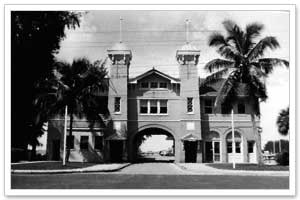
The new Sarasota lift station project is proposing a crude rehashing of the historic city hall in a bad site. The fundamental flaw in the design of this building lies in that the Hoover Arcade originally meant to celebrate its (and the city’s) relationship to the bayfront rather than being placed inland at a highway junction. 

To preëmpt any such arguments, “borrowing” or “referencing” is no excuse here. If an architect chooses to work in a traditional language (or in this case, replicate an historic building), they must do it with authentic attention to details, even if the interior construction techniques are more contemporary. Keeping in mind that the form of a preservable building should not limit a wide range of functions, the following points indicate where the new design falls short on recreating the old building authentically:

– There aren’t supposed to be four pseudo-“minarets” surrounding the building. Just two towers. Which aren’t as fat as in the renderings (which obviously done in and perhaps limited by Sketchup). Léon Krier would likely describe this as an example of the “obese” trend in postmodern imitations of traditional architecture.
– The new brackets are too long and don’t even rest against a rudimentary entablature.
– The second story roof in the middle is shoddily done because, as ornamentation, it’s merely applied to the surface rather than articulating any aspect of the building’s tectonic characteristics. The original third-story mini-roof actually functioned  as a roof in the Hoover Arcade.
– Why the fake McMansard? The roof’s not supposed to be a parapet, but an actual roof. This is important because the lateral width, especially as perceived by north(-west)-bound drivers will just look plain awkward with its wide blank walls on the sides of the archway on the side. Having a real roof would limit this width and make the dimensions of the side wings read more coherently with the dimensions of the front. 
– There are no pediments over the tower doorways. Speaking of which, do all those arches even function as doorways? Arches should be used for celebration of entranceways or articulating vertical elements, not to be plopped around indiscriminately on every opening on all façades.
– The “3 against 2” window-to-arch relationship is awkward at best.l

 
Sarasota would be far better served by actually reconstructing the Hoover Arcade at the end of Main Street. Old aerials indicate that, even with US-41 along the waterfront, there was little spatial reasoning behind the original demolition. It would frame lower Main Street far better, could give the Visitor’s Center a more easily accessible location, and if the argument of historic falsification comes up, just put a plaque in front of it saying it’s not the original building. What’s important is how the building generates meaning to users of the space, and correcting a historical cultural error is a fine reason to do this.

Materiality of Ornament

To what extent does contemporary architectural ornament distinguish itself from past ornament? What gives it strength compared to postmodern and vernacular ornament? Which of its characteristics may contribute to its success or downfall?

Picon opens the first chapter of his “Ornament: The Politics of Architecture and Subjectivity” with three samples of spiraling ornament in contemporary architecture: Evan Douglis’s ceiling in the Choice Market café in Brooklyn (2010), Sauerbruch Hutton’s Boehringer Ingelheim Pharmacological Research Laboratories (2002), and the John Lewis department store façade by Foreign Office Architects (2007). As he notes, contemporary approaches to ornament are strikingly diverse, and, as in the case of the Douglis ceiling, “plays out along the porous border between refinement and kitsch” (p 17). Even when modernism became the de facto architectural approach of the twentieth century, ornament managed to sneak in despite Adolf Loos’s criticisms; Picon cites the precious stones used in the Barcelona Pavilion, or Le Corbusier’s wish for concrete to keep the marks of its production. Another example that comes to mind are the curviliniar designs of Oscar Niemeyer.

What seems to be a common underlying theme in these examples of contemporary and modernist ornament, except perhaps in some of Niemeyer’s works, is a close attention to material and its behavior and properties. These, it seems, are the driving forces behind ornamentation in general, both in our time and prior. Picon mentioned that architecture tended to imitate itself more than imitating nature, as had been more so the case in the other arts, but perhaps the strongest ornament is indeed that which reflects nature in one way or another, be it in Le Corbusier’s stressing on the visual leftover of handiwork, or, in the case of the John Lewis department store, what seems to be mathematically-driven patterning with the qualities of the random traces in a slab of marble in Niemeyer’s Manchete Building or van der Rohe’s Barcelona Pavilion.

It is perhaps for this reason, then, that postmodern ornament seems so “tacky,” “kitschy,” or “low-brow:” it is not as respectful of material as ornament should be in order to succeed. This lack of attention to materiality may be why, for instance, contemporary Mediterranean revival in Florida and California feels so fake – it become exceedingly obvious that the envelope is an exceedingly superficial shell rather than really engaging with the (often cheap) materials in the unseen part of the building. Further, I would posit that another weakness of postmodern ornament is the lack of continuity and common underlying language. Despite Le Corbusier’s demeaning accusations against it in his “Vers une Architecture,” the architectural-linguistic continuity afforded by style seems to contribute to the success of any movement of architecture, and even modernism, which itself fell into style (or perhaps, because sub-movements of modernism could be interpreted as acting excessively representative of the aspirations of their time, fashion).

Is contemporary ornament repeating this postmodern hamartia? At least there’s the underlying common factor of computer-aided design in so much of successful contemporary ornament (maybe I shouldn’t use the word ‘successful’ without defining it…), and as demonstrated by Zaha Hadid’s design for the Marsa Dubai Residential Tower (2005) and de Herzog and Meuron’s Beijing National Stadium (the bird’s nest), references to existing ornamental tradition and to nature as well. These three italicized points, I find, will be the key for the contemporary internal disciplinary acceptance of ornament.

Regardless of these three supporting factors, ornament often seems to teeter on the edge arbitrariness. This could be the strength of the classical orders, to which Leon Krier returned (pp 24-25) – despite the fact that stone classicism came out of imitating the visual result of building temples out of wood (Choisy in p 39, caption), the tradition continued to evolve with attention to the materiality of ornament. While postmodern ornament too arguably had a cultural precedent, as Venturi described in his “Learning from Las Vegas,” it played a more symbolic role than a tectonic one; indeed, Picon lists “typology, composition and … symbolic potential” as the “more pressing issues” of postmodern architecture.

And what of the mass (re)production of ornament in the late nineteenth-century, compared to postmodern mass production? Picon (p 37) suggests that this may have contributed to loss of meaning and artistry in ornament and almost certainly contributed to Loos’s backlash against ornament (Ibid.). Regardless of this, there remains the strength of a strong material connection that lacks postmodern and much contemporary vernacular ornament – this is what distinguishes the two and why late-nineteenth-century ornament is arguably so much stronger and more authentic despite its downfalls.